
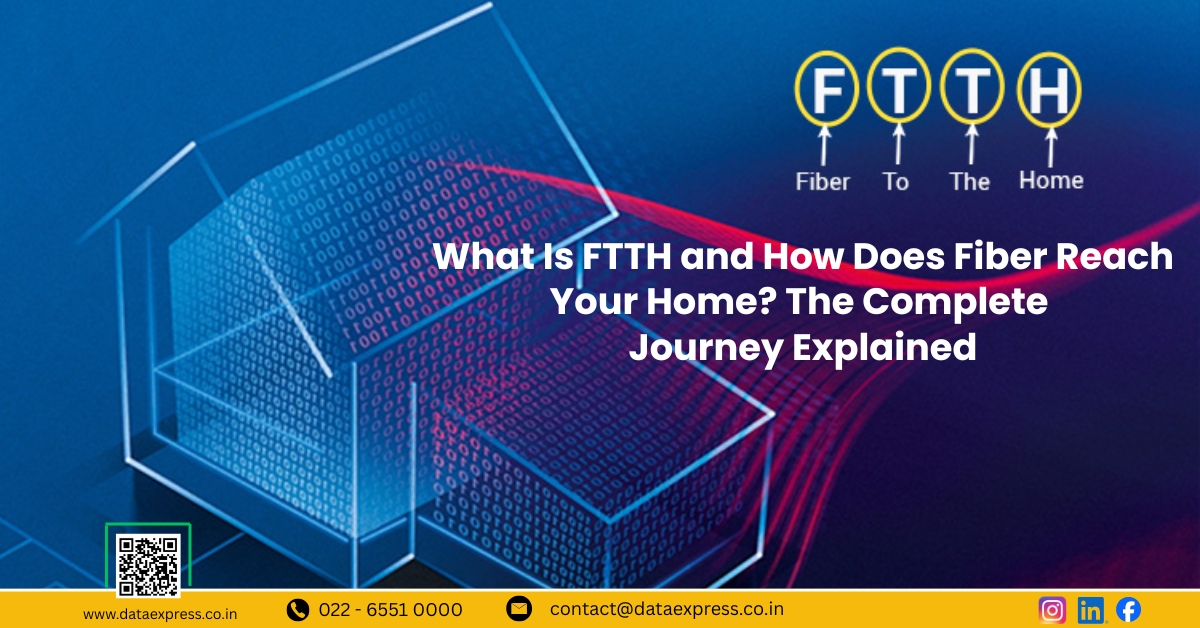
What Is FTTH and How Does Fiber Reach Your Home? Complete guide
Ever wondered how people look crystal clear through video calls, or how a movie starts playing instantly on your Smart TV, or how fast you get solutions to your questions on the net? NO, right? We all use these technologies daily, but we never take the time to understand the procedures, the journey, and the science behind them.
Well, let’s get curious and dive in together to find the solutions behind these questions. In today’s world, the Internet is everything, and it is growing rapidly across businesses and homes alike. Traditional connectivity methods are setting a pathway for more advanced infrastructures and technologies. ‘FTTH’, also known as ‘Fiber To The Home’, is onea of the most advanced technologies and a very successful outcome of our traditional connectivity methods.
From remote work to online education, from 4K streaming to cloud applications, FTTH connections have now become very crucial in our day-to-day use. The majority of us enjoy the benefit of high-speed internet, but very few actually have the knowledge about the journey of the data before it reaches our homes.
So, here stands the question: What is FTTH? How does the fiber reach all the way to our homes from those internet service providers’ networks?
Let’s calm our curious selves and start exploring.
What is FTTH?
FTTH, aka fiber To The Home – the name itself signifies its value. It is a broadband network architecture in which the fiber optic cables are deployed directly from the internet service provider’s network to the customer’s premises.
Conventional broadband network connection technologies rely on copper cables for the final connection, unlike FTTH connections, which directly drop off the fibers to our houses. This eventually causes significantly higher speeds, lower latency, better performance, and greater reliability.
Here at DataExpress, we understand the need for network speed as well as the quality of the same, and therefore our approach remains entirely on delivering reliable connectivity that matches both present and future connectivity.
Why has FTTH Network become so important?
Years ago, the scenario was different; the internet was used, but it was not a necessity back then, it was used occasionally for checking emails, browsing websites, and occasionally streaming videos.
But fast forward to today, the scenario is completely different; now every typical household has:
- Smart TVs streaming 4K content
- Smartphones and tablets
- Work laptops
- Video conferencing platforms
- Online gaming applications
- Security cameras
Each of these devices consumes bandwidth, and the more devices connected, the more difficult it is for the traditional broadband network connection infrastructure to maintain its performance. This growing demand was resolved due to FTTH connection, which not only handles higher data volumes but also maintains stable connectivity and hence keeps the customers happy.
Understanding Technology behind Fiber Optics
It is important to understand the technology that powers FTTH Network so as to understand its efficient performance.
As mentioned before the information that is transmitted through the fiber cables are in the form of light pulses, but did you know that fiber optic cable is not just a single wire, in fact, it consists of extremely thin strands of glass or plastics that carry the information. Whenever any of the digital activities are done like streaming, video calls,etc., the data travels through the fiber cables at high speed before it is converted back to the digital information that is seen on your device.
The ability to carry data in large amounts makes this technology the perfect choice for modern telecommunications networks worldwide.
The Journey:
Where Does the Internet Actually Come From?
- People automatically assume that their Internet connectivity starts with their internet service provider (ISP), but is this the reality?NO, the Internet connectivity journey starts much farther away.
- There is a vast network of undersea fiber optic cables that connects countries and continents, and these cables carry heavy internet traffic every second, which therefore enables communication between various data centres, businesses, governments, consumers, basically everyone all around the world.
- An interesting fact is that when you visit a website or watch a video, the information of the window that pops on your screen might have travelled thousands or maybe even millions of kilometres before eventually reaching your home.
How Fiber Travels across the Network?
- Now we know that the information might have travelled internationally through the undersea cables before reaching your device, but what happens after it reaches our country? Well, once the international internet traffic enters a country, it passes through high-capacity national backbone networks. Consider these backbone networks as digital highways that connect telecom exchanges, data centres, internet gateways and many other factors that are required in the process.
- The distribution works in the form of a hierarchy, first comes international, then national, and then comes the next level that is urban centres, once the data reaches this level, it goes through fiber networks that eventually distribute the connectivity across commercial, residential and industrial areas. And after this comes the Local level, where the local distribution points bring the fiber infrastructure closer to neighbourhoods and communities.
- Once international internet traffic enters a country, it is distributed through high-capacity national backbone networks. Think of these networks as digital highways that connect internet gateways, data centres, telecom exchanges, and major cities.
- Reliability and the quality of the Internet are solely dependent on the strength of the fiber infrastructure. Here’s when DataExpress comes into picture, we have focused on building and expanding across multiple regions and helping with the growing demand for reliable broadband internet connection and enterprise connectivity solutions.
How is Fiber Distributed across Multiple Homes?
- Other than cables, there are many other important components of FTTH, one of them is Optical Line Terminal, also known as OLT, think of it as the head of the family i.e., it acts as the control centre of the network. Its main responsibility is to manage the communication between the internet service providers and subscribers, and also distribute the internet traffic efficiently.
- One of the architectures used to deliver this technology is PON, which stands for Passive Optical Network. This architecture uses optical splitters that divide a single fiber signal into multiple possible pathways, allowing one fiber to reach multiple homes simultaneously.
FTTH technology is therefore the best choice because these components require minimal maintenance and are highly reliable at the same time.
The Finale of FTTH Journey into Your Home
- The final point, where the journey of the data comes to an end is at your home. It goes through all the levels of the network infrastructure, but the connection is still not at its final step until the information is seen on your device. The connection continues through a fiber drop cable that connects your home to the network.
- Ever heard of Optical Network Terminal, i.e., ONT, it is a device to which the cable is connected once the cable enters your home. ONT is responsible for converting the light signals into the digital information that your devices can understand.
- Nowadays, every house has a Wi-Fi router, and this Wi-Fi router is connected to the ONT as well. No matter what devices you are using, be it laptops, smartphones, etc., the Wi-Fi router ensures seamless connectivity and uninterrupted network throughout your space.
The Future Is Fiber
As we’ve seen throughout this journey, FTTH technology is more than just faster internet; as opposed to traditional broadband, it offers higher speed, lower latency, greater reliability and many more benefits. However, behind a great fiber experience is a reliable Internet service provider (ISP) that makes sure to invest in robust fiber infrastructure, reliable service and dependable support.
This is where providers like us, DataExpress, a FTTH network company in Navi Mumbai plays a crucial role, we are more than just your Internet service provider, we are your friend, we are your ally, we are the ones that will stand with you when your network goes down, we are the ones that will provide you with our best plans we are the ones that promise to never let you down.
Source – Fiber To The Home